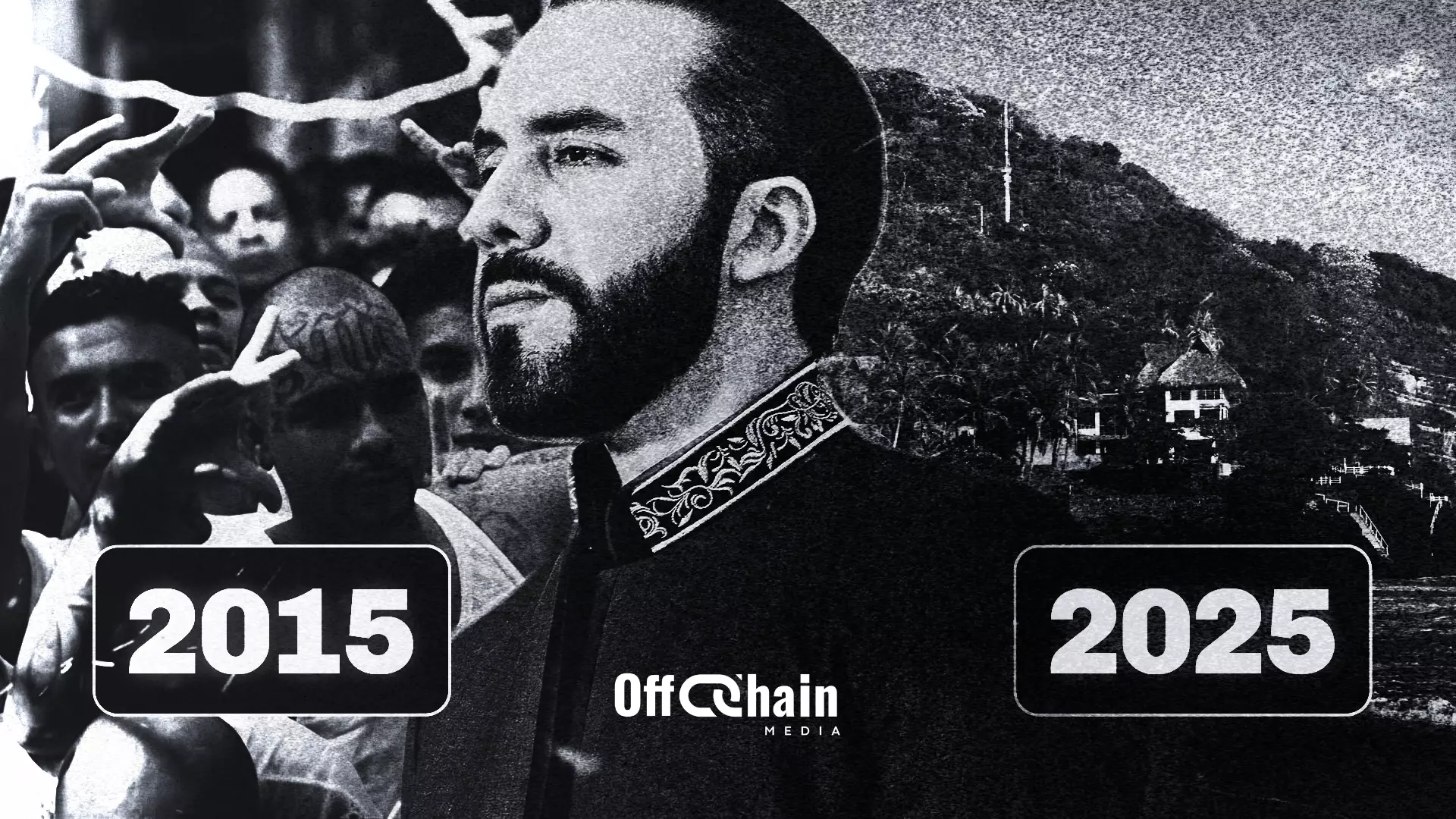
One month of reporting to go beyond the narratives
For some, El Salvador's Bitcoin law represents a historic step toward monetary sovereignty, driven by a visionary president. For others, it illustrates precisely the opposite: a top-down decision imposed without democratic debate, in a country where a state of emergency has been in place since 2022 and where more than 80,000 people were incarcerated within months in the name of gang suppression.
It is to navigate this tension that Off-Chain Media spent a month in El Salvador, meeting citizens from all walks of life — supporters of Nayib Bukele as well as his opponents, including Claudia Ortiz, a member of the Legislative Assembly.
The result is a 90-minute documentary: "From the Most Dangerous Country in the World to Bitcoin Adoption: El Salvador's Transformation."
🎥 Watch the full documentary on YouTube
To understand Bukele, context matters. Elected in 2019 with 53% of the vote, he embodied the hope of restoring order in a country shaped by decades of gang influence. The security policy that followed was praised by a large majority of Salvadorans, while drawing sharp criticism on human rights grounds.
It is in this context that the Bitcoin law was passed, perceived by part of the population as yet another measure imposed without consultation. A perception the documentary sets out to interrogate, without attempting to answer on behalf of the viewer.
🪙 Is Bitcoin (BTC) Really a Currency?
What the ground reveals
On the ground, the reality of adoption is more nuanced than the discourse suggests. Bitcoin circular economies do exist, notably in El Zonte and Berlín, but outside tourist areas, everyday use of Bitcoin remains marginal. Many merchants, gradually, have stopped accepting it, regardless of what the law required.
At the end of 2024, an agreement between El Salvador and the IMF amended the "Bitcoin Ley": the obligation for merchants to accept BTC was removed, the ability to pay taxes in Bitcoin was abolished, and the government withdrew from managing the Chivo Wallet. These adjustments reignited debate over the durability of the Salvadoran experiment.
What endures, however, are the educational programs. Mi Primer Bitcoin and Node Nation continue training younger generations in Salvadoran schools, building adoption grounded in understanding rather than legal obligation.
The question the documentary raises remains open: is Bitcoin adoption in El Salvador the result of collective conviction or an authoritarian decision? The ground does not settle the matter, it mostly forces us to think in shades of grey.